This page is a personal remembrance of Walter, VE7BGJ, whose patience, knowledge, and companionship helped shape the amateur-radio lives of many people in the Lower Mainland.
A remarkable operator
Walter Melvyn Hendrickson (June 30, 1940 – June 6, 2025) was born blind and later became hard of hearing. Neither challenge kept him from being a deeply engaged amateur-radio operator. He was a superb CW operator, took part in regular CW nets, and was heard daily on the Rainbow Country Net, where he shared his experiences and good humour with fellow operators.
Walter used a text-to-Morse converter to read email. He attended many Lower Mainland amateur-radio events—usually with his good friend Lou, VE7CGE, providing transportation—and was a familiar face at the SPARC Radio Museum, at North Delta gatherings, and at the Thursday coffee get-together at Fresgo. His knowledge of radio was matched by his knowledge of old cars and engines.
146.58 MHz — “Walter’s frequency”
For many Lower Mainland amateurs, Walter’s callsign immediately brings to mind 146.58 MHz FM simplex. Walter monitored this two-metre frequency so faithfully that it became known as “Walter’s frequency.” A new amateur’s first QSO was often with Walter: a friendly voice, an encouraging contact, and a practical welcome to the hobby.
Simplex means that two stations talk directly to one another on the same frequency, without using a repeater. That made 146.58 MHz an especially personal local meeting place—one where anyone within radio range could call, listen, and find Walter. The Canadian two-metre band plan places 146.400–146.595 MHz in the FM-simplex portion of the band and specifically lists 146.580 MHz among its channels.
A teacher at Burnaby Amateur Radio Club
Back in 1978, Walter tried to teach me Morse code at the Burnaby Amateur Radio Club so that I could earn my Amateur Radio certificate. In those days, the traditional route required 10 words per minute CW, as well as the ability to draw radio circuits by hand and explain what each part did.
The technical side was no problem for me. I had taken Electricity 9 and Physics 11 and 12 in high school, so I could draw the circuits and explain their components. The Morse code was the challenge Walter patiently worked on with me.
The no-code option
In 1978, the Department of Communications introduced a no-code path commonly called the Digital Amateur licence. It involved learning technical concepts such as channel saturation, digital transmission, and ALOHA-style access systems. That material was also comfortable for me.
But Walter, VE7BGJ, and Lou, VE7CGE, encouraged me not to choose that route. The licence was for VHF and UHF operation and did not include the HF bands. They felt I would have more fun on HF.
Having served as a military HF MOC R211 operator, I was tired of listening to static on HF and was more interested in the possibilities above 30 MHz. This was all before I moved to Seattle in 1978. In time, the Digital Amateur class disappeared because few people chose it.
Coming back to amateur radio
In January 1990, after the older Digital Amateur class had been dropped, I wrote both the new Basic no-code examination and the Advanced Amateur examination. I walked out with qualifications that were the equivalent of—and in some respects broader than—the earlier Digital Amateur privileges.
I had become good at writing exams. Every few years I also had to renew my Level 3 First Aid qualification by writing an examination with about 10% new material. The habits of studying and keeping current served me well.
A lasting place in the community
Walter lived first with his parents and later with Neil, VE7NH, who cared for him. Walter moved with Neil from Burnaby to Delta and eventually to Chilliwack, but remained a well-known and valued part of the Lower Mainland amateur-radio community.
At Field Day, Walter was an important member of “Team CW.” His operating style gave listeners extra Morse-code practice: he made each contact a real conversation and repeated what he heard. That patient, unhurried manner was also the Walter I knew at the Burnaby Amateur Radio Club—an Elmer who gave his time to help someone else learn.
On the Burnaby Amateur Radio Club net, Walter operated the Swap and Shop portion, where operators could list their used equipment for sale. It was a useful service for local hams and another example of Walter’s steady contribution to the club community.
Walter also ran CW drills on the ten-metre band around 28.010 MHz. Those practice sessions gave operators a place to build confidence with Morse code, and they reflected the same patient commitment to teaching that I experienced firsthand.
A final visit
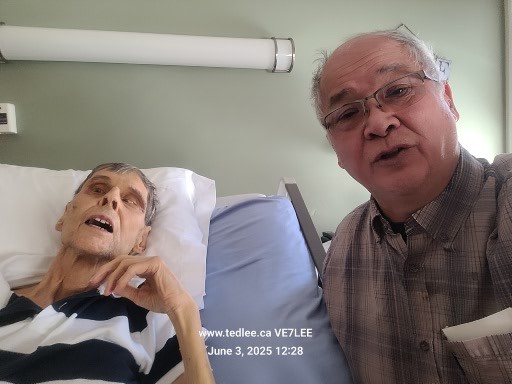
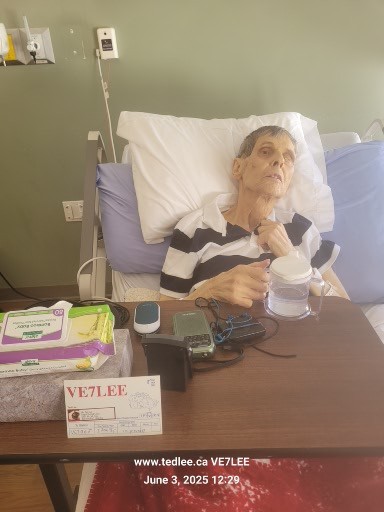
I visited Walter at hospice a few days before he became a Silent Key. These photographs, taken June 3, 2025, are an important memory of that visit: Walter still had radio equipment close at hand, and the callsign VE7LEE was beside him.
About this remembrance
This account combines Ted Lee’s personal recollections with the Delta Amateur Radio Society memorial. Current Canadian amateur-radio certificates use Basic, Morse Code, and Advanced qualifications; licensing structures and terminology have changed over the years.
Sources
- Delta Amateur Radio Society: “Walter Melvyn Hendrickson VE7BGJ” — biographical details, Walter’s 146.58 MHz monitoring, and his community activities.
- Radio Amateurs of Canada: Canadian Amateur Two Metre Band Plan — current FM-simplex designation and 146.580 MHz channel listing.
- Ted Lee, VE7LEE — personal recollections of Walter’s CW instruction and encouragement at the Burnaby Amateur Radio Club.